A look back ten billion years – with SDR, interferometry and amateur radio know-how
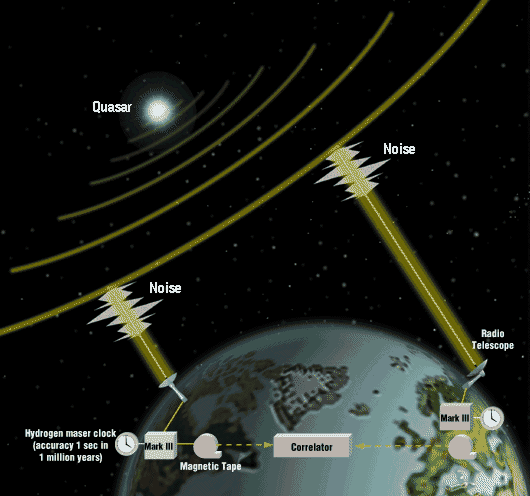
March 31, 2026In preparation for the manned NASA Artemis II mission, the radio telescopes in Bochum (20m) and Dwingeloo (25m) in the Netherlands have for the first time carried out a joint observation of the distant quasar J2136+0041. Both facilities were operated as interferometers – a method in which two spatially separated antennas are synchronized in such a way that they act as a single large virtual telescope with a baseline of several hundred kilometers. This principle is also commonly referred to as Very Long Baseline Interferometry (VLBI), a technique that enables extreme angular resolutions and makes even tiny structures in the sky visible.
Results Dwingeloo and Bochum combined as VLBI
Quasar QSO J2136+0041
The observed object is anything but ordinary. Quasars are among the most energetic phenomena in the cosmos. They mark the centers of young galaxies in which a supermassive black hole devours enormous amounts of matter. This releases enormous amounts of energy, which can still be measured as intense sources of radiation even billions of light years away. The observation was made in the S band, a frequency range that plays a central role in both space communication and radio astronomy. Quasars are excellent reference sources in the radio range – stable, bright and measurable over cosmological distances.
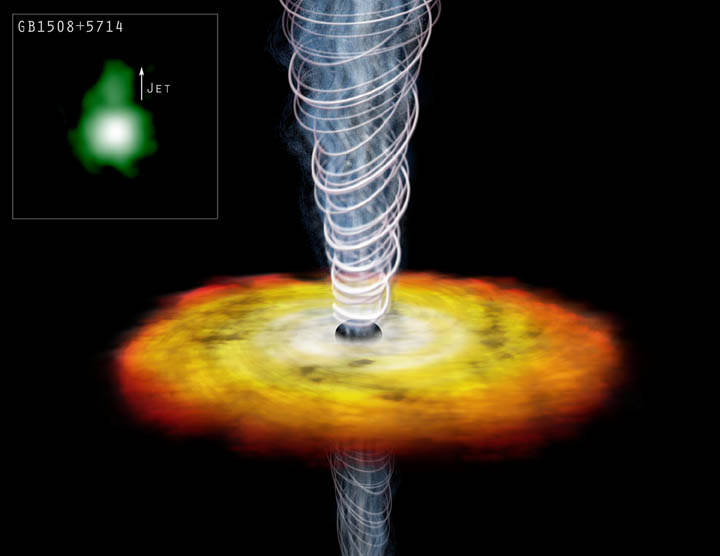
Illustration of the quasar GB 1508+5714 with an embedded X-ray image from the Chandra Space Telescope (source: NASA)
10 billion years of travel time at the speed of light
The temporal dimension of this measurement is particularly impressive: the radio waves of QSO J2136+0041, which were received in Bochum and Dwingeloo, have traveled around ten billion years at the speed of light – they were emitted when our solar system did not even exist yet. They originate from an epoch when the universe was still young and our Milky Way was just beginning to take on its present form. By comparison, our solar system has only existed for around 4.6 billion years. The signals received are therefore more than twice as old as the Earth itself!
Software-defined radio technology (SDR)
Modern Software Defined Radio technology (SDR) was used – an approach that many radio amateurs are very familiar with. Instead of specialized, hard-wired reception technology, software and digital signal processing do the main work: sampling, filtering, frequency conversion and correlation are computer-aided. Clean time references, stable oscillators and precise signal processing are crucial, especially for extremely weak signals, such as those arriving from billions of light years away. Principles that also play a central role in EME operation, in digital weak signal modes or in our own amateur VLBI experiments.
But why is all this relevant for a moon mission? In space travel, quasars are regarded as almost immovable fixed points in the sky. Their enormous distance makes them ideal for calibrating antennas, checking reception chains and referencing navigation and communication systems. For Artemis II, such observations provide important comparative data for reliably designing and testing radio links in near-Earth and cislunar space.
The project impressively demonstrates how space travel, radio astronomy and amateur radio technology are mutually beneficial. With relatively straightforward hardware, intelligent software and precise cooperation, signals can be received that have been traveling longer than the Earth is old. For radio amateurs, this is a powerful message: their own tools and experiences are based on the same physical principles as the major scientific missions – just on a different scale.
In the end, this experiment combines extremes: state-of-the-art digital radio technology meets radio waves from the early days of the universe.
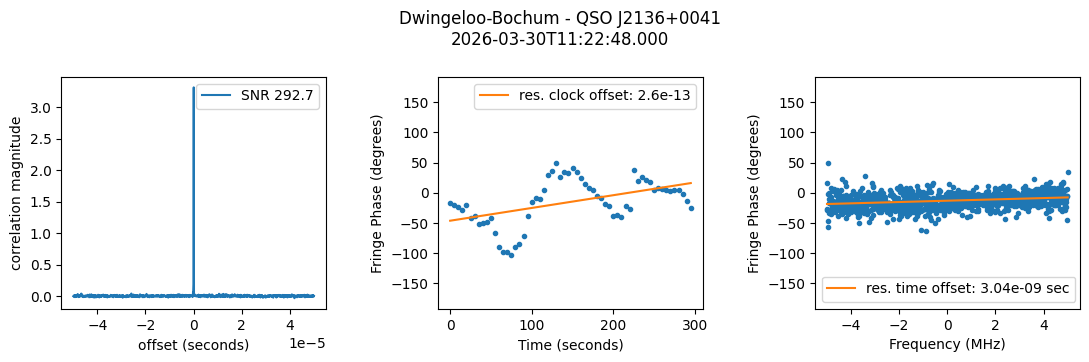
After reception, the data streams from both locations were correlated with each other in order to make the characteristic interference patterns visible. This correlation is a key step in interferometry: the typical interference signal, from which high-precision astronomical information can be obtained, can only be produced if the time base, frequency reference and data streams match perfectly.
Conclusion
For the Bochum Observatory and the radio community, this project impressively demonstrates how amateur astronomy and professional radio astronomy can grow together. With modern SDRs, precise time sources and international cooperation, measurements can be made that a few decades ago were reserved exclusively for large observatories. This technology also works on a smaller scale than just 25m or 20m radio telescopes and opens up new interesting areas for radio amateurs to expand their knowledge. We will continue to expand our joint cooperation with the Dwingeloo radio telescope, as they have much more experience and know-how in radio astronomy than the Bochum Observatory. In addition to deep space communication with spacecraft in interplanetary space and around the moon, there are many new opportunities here, also in the field of education and research.
Peter Gülzow, DB2OS
Thomas Telkamp, PA8Z