The 100 key players in the space scene – Associations
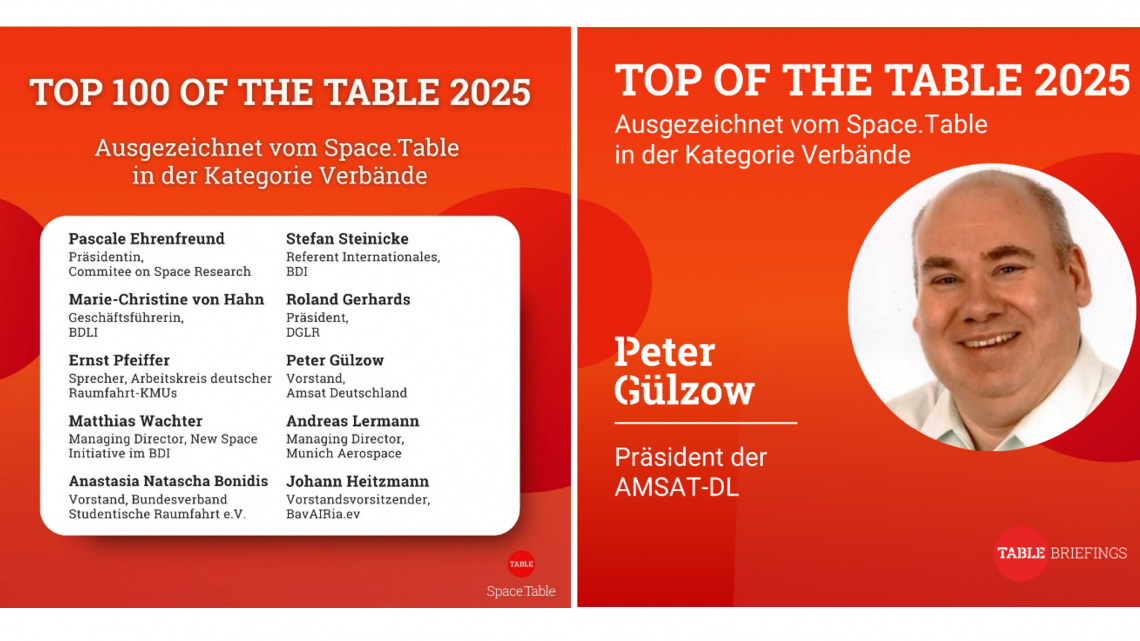
February 19, 2026Our 1st Chairman Peter Gülzow DB2OS is one of the “Top 100 of the Table 2025/26”: the 100 key figures in the space scene, the ten most influential leaders in the associations category, selected by the editors of Space.Table. There are ten categories in total, ranging from politics, companies, consulting, associations and think tanks to foundations, science, NGOs and society.
Peter’s comment on this:
I am delighted to be included in the “Top 100 of the Table” of the Space.Table Professional Briefing.
The space editors of table.media have honored me as one of the ten formative minds in the associations category. However, I see this recognition not only as a personal award, but above all as a tribute to an extraordinary community: AMSAT!
For more than 50 years, the global AMSAT community has been developing, building and operating small satellites – driven by voluntary commitment, enthusiasm for space travel, passion, technical excellence and a clear vision.
If AMSAT were a “space nation”, we would rank about 10th in the world with over 130 amateur radio satellites launched. This is a remarkable result for a non-governmental organization run by volunteers.
This “virtual space program” includes
- the OSCAR satellites (Orbiting Satellite Carrying Amateur Radio),
- Contributions from sister organizations such as AMSAT-US, AMSAT-UK, AMSAT-F, AMSAT-IT, AMSAT-India, AMSAT-EA and others,
- numerous small satellites, CubeSats and PocketQubes,
- University missions with amateur radio payloads on coordinated amateur radio frequencies and involving radio amateurs as a network of ground stations.
Historically speaking, AMSAT would be even further ahead:
With OSCAR-1 (December 12, 1961) – just four years after Sputnik – AMSAT would be the third first space nation in the world to launch a satellite, right after the first US satellite Explorer-1 in January 1958.But it is not just the number of satellites that is decisive. The decisive factor is the effect.
Without the commitment of thousands of volunteer radio amateurs who are space enthusiasts, there would be no or less:
- many of today’s space experts,
- numerous CubeSat initiatives,
- and some New Space start-ups probably either.
AMSAT was and is an incubator for technology, training and entrepreneurial thinking in the space sector. Generations of radio amateurs, students, engineers and founders have been shaped by this platform.
However, against the backdrop of growing commercial mega-constellations and increasing regulatory consolidation, a central question arises:
What role will non-commercial, experimental satellite radio play in the orbit system in the future?
Amateur radio via satellite is not a nostalgic relic. It is:
- low-threshold access to space travel for the next generation,
- an experimental testing ground for new technologies,
- an international cooperation model beyond geopolitical tensions,
- and a building block of technological sovereignty – also in Europe.
This requires reliable frequency protection, regulatory planning security and a political framework that does not suppress voluntary innovation structures, but recognizes them as part of the space ecosystem.
Space travel is not only created in government programs or commercial constellations. It is also created where technological passion, international cooperation and long-term vision come together.
My heartfelt thanks go to the entire team at AMSAT-Deutschland e.V., my fellow board members and the international AMSAT community. Without this collective commitment, none of this would be possible.
I look forward to exchanging ideas with players from industry, politics and the amateur radio community.
Because sustainable space travel not only needs capital and infrastructure –
it also needs open frequencies, freedom to experiment and committed people.